← 返回线下交流 · 课件馆
Hysteroscopy Anesthesia Self-Guided Course 面向 Cornell 大一见习学生的中英双语自学课件 Bilingual self-guided course for a first-year Cornell student observer

Self-Guided OR Observation

宫腔镜手术全身麻醉自学课 General Anesthesia for Hysteroscopic Surgery

这套课件给学生自己看:用子宫息肉或异常子宫出血的宫腔镜手术,理解短小妇科手术里的全麻流程、膨宫液安全、监测重点和苏醒观察。 This course is designed for independent reading: use hysteroscopy for uterine polyps or abnormal uterine bleeding to understand general anesthesia workflow, distension fluid safety, monitoring priorities, and recovery checks.

AUB 异常子宫出血 abnormal uterine bleeding
GA 全身麻醉 general anesthesia
9 英文标识教学图 English-labeled figures
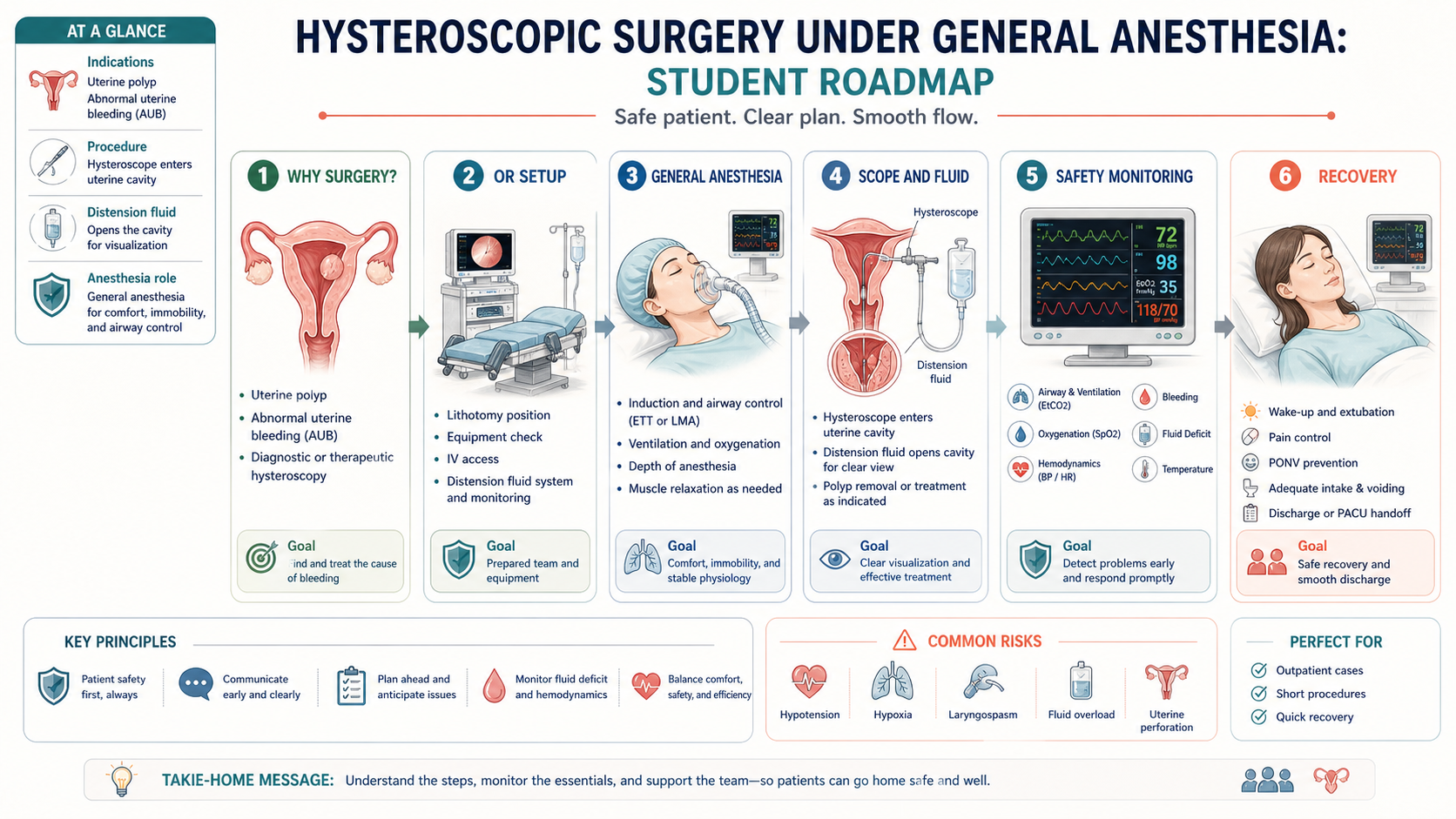
Hysteroscopic surgery anesthesia student roadmap
先看总路线:为什么手术、全麻做什么、宫腔镜如何看见病变、膨宫液为什么重要、醒来后看什么。 Start with the route: why surgery is done, what anesthesia does, how the scope sees the lesion, why distension fluid matters, and what to check after wake-up.

Start Here

这台手术不大,但麻醉观察点不少Small Procedure, Real Anesthesia Concepts

宫腔镜手术通常时间不长,创伤较小,但它仍然需要完整的麻醉评估和监测。学生要特别关注:为什么病人会异常出血,宫腔镜如何看见宫腔,全麻如何让手术顺利完成,以及膨宫液为什么需要记录。

Hysteroscopic surgery is often short and minimally invasive, but it still requires real anesthesia assessment and monitoring. Pay special attention to why the patient has abnormal bleeding, how hysteroscopy visualizes the uterine cavity, how general anesthesia supports the procedure, and why distension fluid must be tracked.

Uterine polyp AUB Hysteroscope Distension fluid General anesthesia
Self-guided observation route
这张图是学生自己的阅读路线:术前、入睡、气道、镜子、液体、苏醒、复盘。 This is the student's reading route: pre-op, sleep, airway, scope, fluid, wake-up, and debrief.

Why Hysteroscopy

为什么做宫腔镜:直接看见宫腔内问题Why Hysteroscopy: Directly See the Uterine Cavity

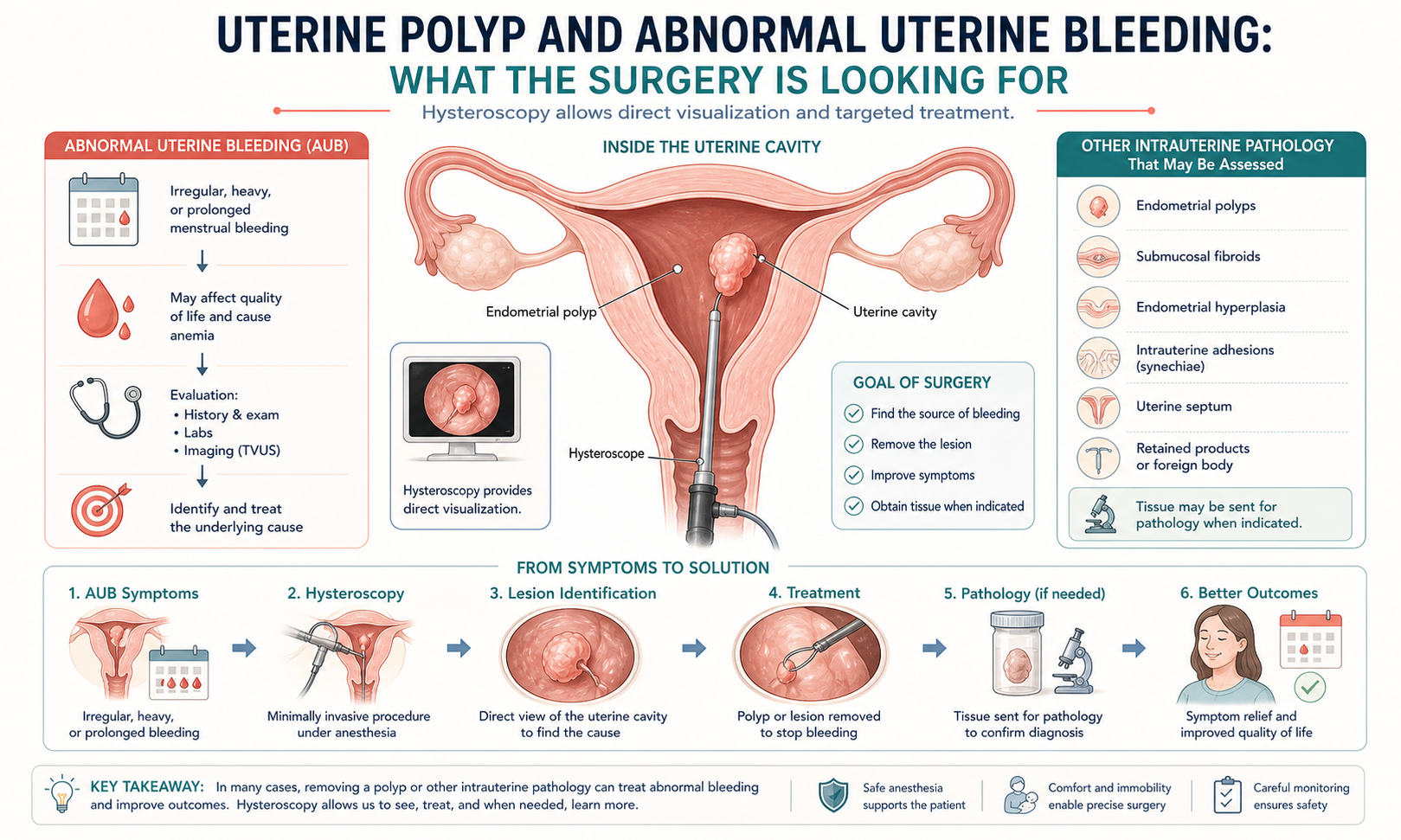
异常子宫出血 `abnormal uterine bleeding, AUB` 可能与子宫内膜息肉等宫腔内病变有关。宫腔镜 `hysteroscopy` 的价值在于:医生可以进入宫腔内直接观察,定位息肉或可疑出血来源,并在适合时进行切除或取材。

Abnormal uterine bleeding (AUB) can be related to intrauterine pathology such as an endometrial polyp. Hysteroscopy allows the physician to directly visualize the uterine cavity, identify a polyp or bleeding source, and remove or sample tissue when appropriate.
What 宫腔内可能有息肉或其他病变。 A polyp or other intrauterine lesion may be present.
Why 直接观察能帮助定位和处理。 Direct visualization helps identify and treat the source.
Watch 看医生如何通过镜子确认病变。 Watch how the lesion is identified through the scope.
Uterine polyp and abnormal uterine bleeding mechanism
从“异常出血”到“宫腔镜找原因”,这是学生理解这台手术的第一步。 From abnormal bleeding to hysteroscopic evaluation: this is the first concept to understand.

What Happens in the OR

宫腔镜手术会发生什么:镜子、光源、液体、处理病变What Happens: Scope, Light, Fluid, and Lesion Treatment

宫腔镜通过宫颈进入宫腔。为了看清楚,手术需要膨宫液撑开宫腔。医生通过镜子观察内膜、息肉或出血来源,再进行切除、取样或其他处理。

The hysteroscope enters the uterine cavity through the cervix. Distension fluid opens the cavity so the physician can see clearly. The surgeon inspects the endometrium, polyp, or bleeding source, then removes, samples, or treats the lesion as appropriate.
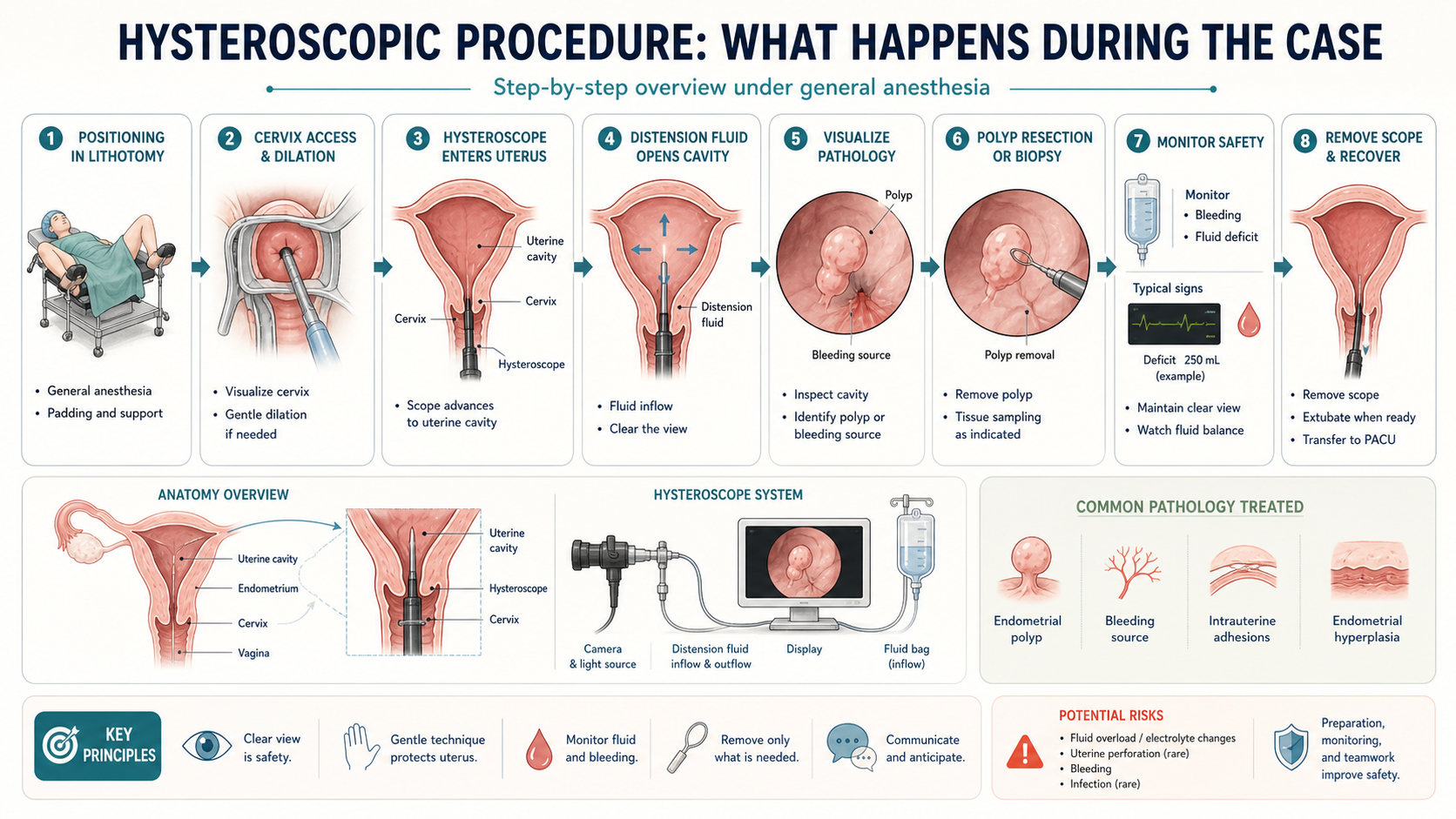
Hysteroscopic procedure overview
学生可以把手术理解为:进入宫腔、撑开空间、看清楚、处理病变、退出并恢复。 Think of the procedure as: enter the cavity, open the space, see clearly, treat the lesion, exit, and recover.
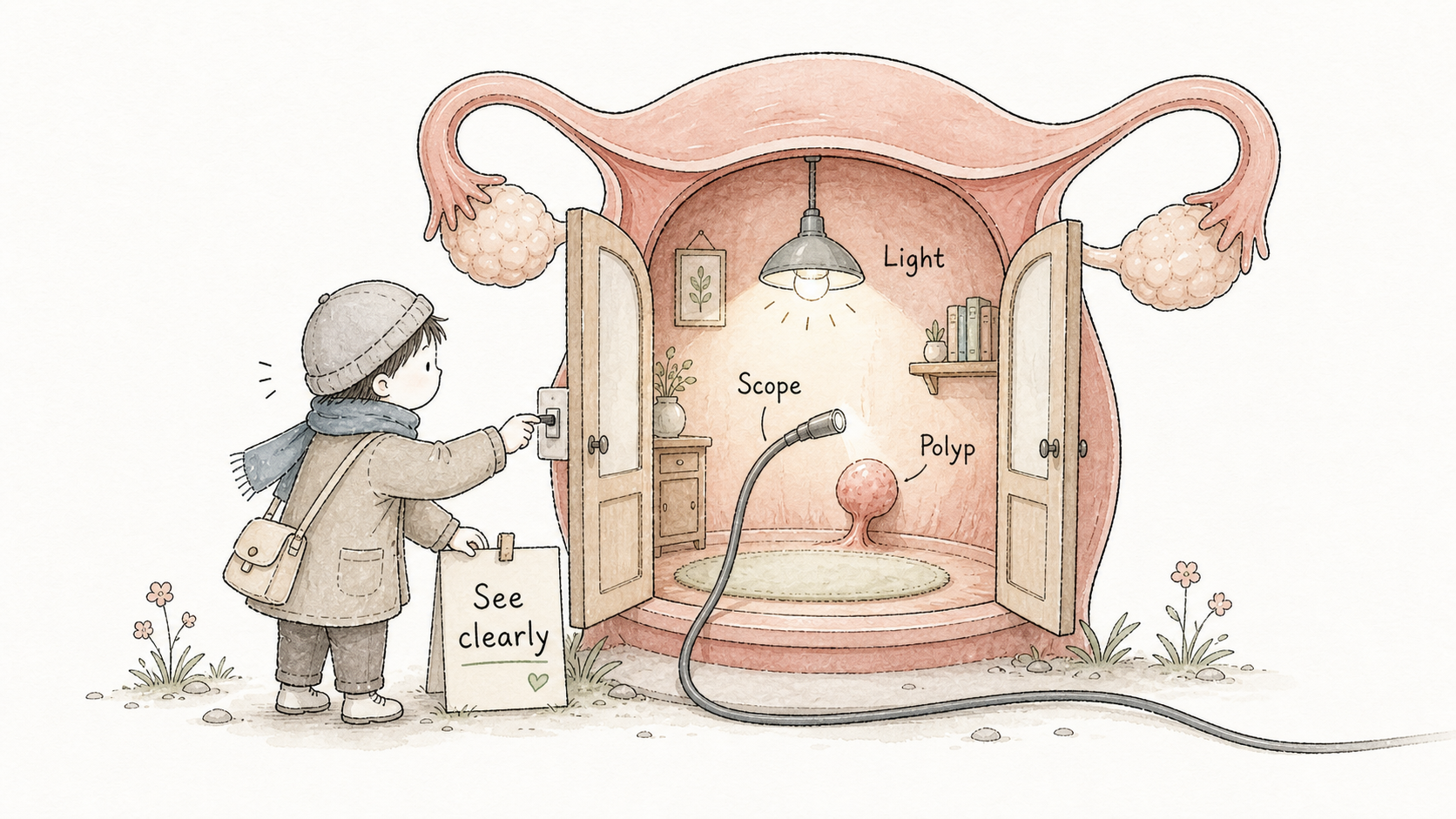
Hand-drawn uterine room metaphor
手绘图把宫腔镜解释成“打开小房间、开灯、看清小问题”。 The hand-drawn figure explains hysteroscopy as opening a small room, turning on the light, and seeing the problem clearly.

Why General Anesthesia

为什么短手术也可能做全麻Why a Short Procedure May Still Use General Anesthesia

宫腔镜可能涉及宫颈扩张、宫腔操作和短时间刺激。全麻可以帮助病人舒适、减少疼痛和不适、保持制动,让手术更顺利。具体气道方式可能根据患者情况、手术长度、误吸风险和麻醉医生判断选择,例如面罩、喉罩或气管插管。

Hysteroscopy can involve cervical dilation, intrauterine manipulation, and brief but real stimulation. General anesthesia supports comfort, pain control, immobility, and surgical conditions. Airway support may vary by patient factors, procedure length, aspiration risk, and clinician judgment: mask, LMA, or endotracheal tube may be considered.
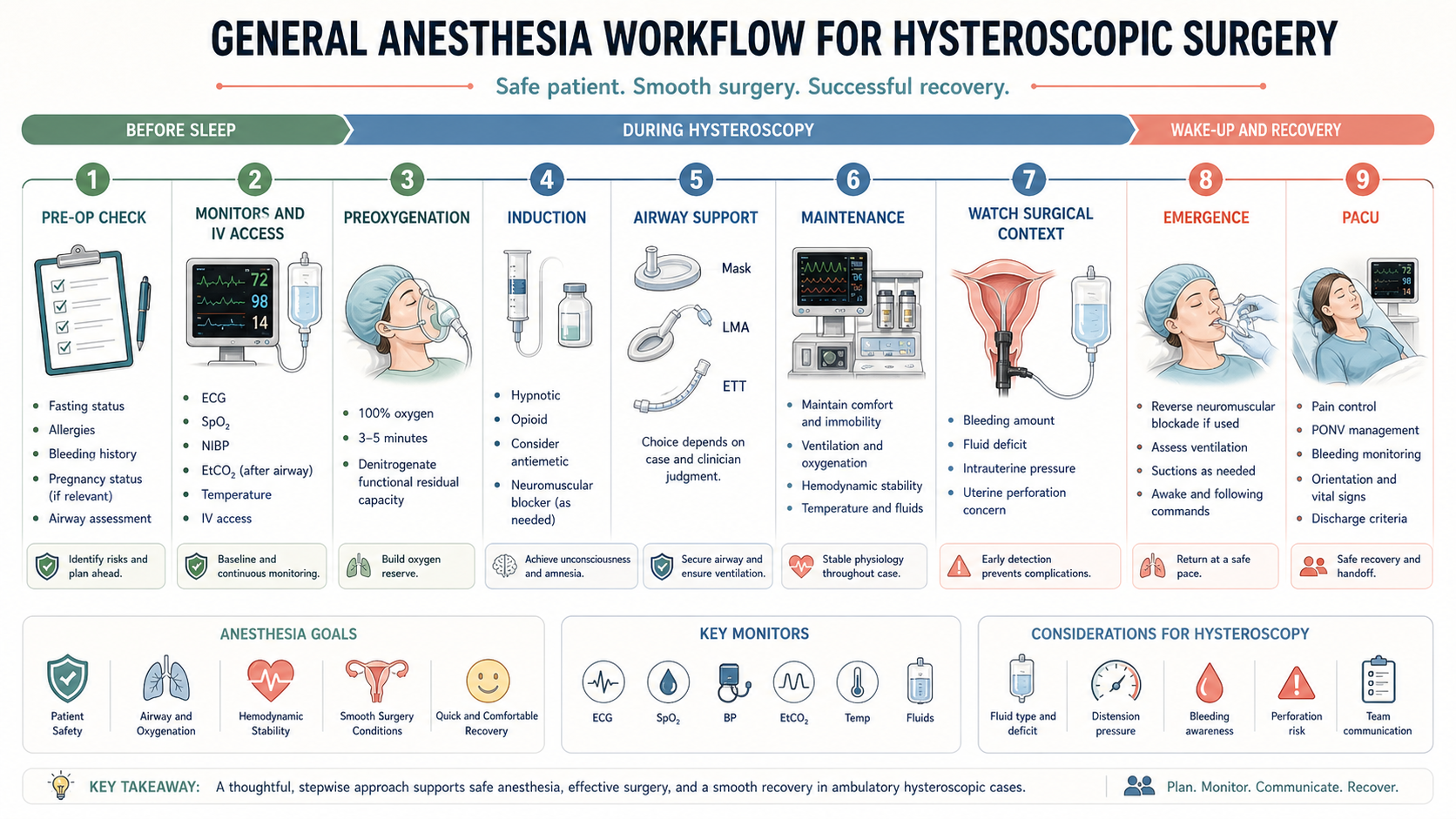
General anesthesia workflow for hysteroscopic surgery
不要因为“手术短”就忽略麻醉流程:术前评估、监测、气道、维持和苏醒都仍然重要。 Do not ignore anesthesia just because the procedure is short: pre-op assessment, monitoring, airway support, maintenance, and wake-up still matter.

Distension Fluid

最容易忽略的安全点:膨宫液和 Fluid DeficitThe Hidden Safety Concept: Distension Fluid and Fluid Deficit

宫腔镜需要膨宫液撑开宫腔。进入的液体 `inflow` 和流出的液体 `outflow` 需要记录,两者差值叫 `fluid deficit`。如果液体吸收过多,可能出现液体负荷过多、电解质异常或肺水肿等风险,具体风险与液体类型、手术时间和患者情况有关。

Hysteroscopy uses distension fluid to open the uterine cavity. Inflow and outflow are tracked, and the difference is the fluid deficit. Excess absorption can contribute to fluid overload, electrolyte problems, or pulmonary edema risk, depending on fluid type, procedure duration, and patient factors.
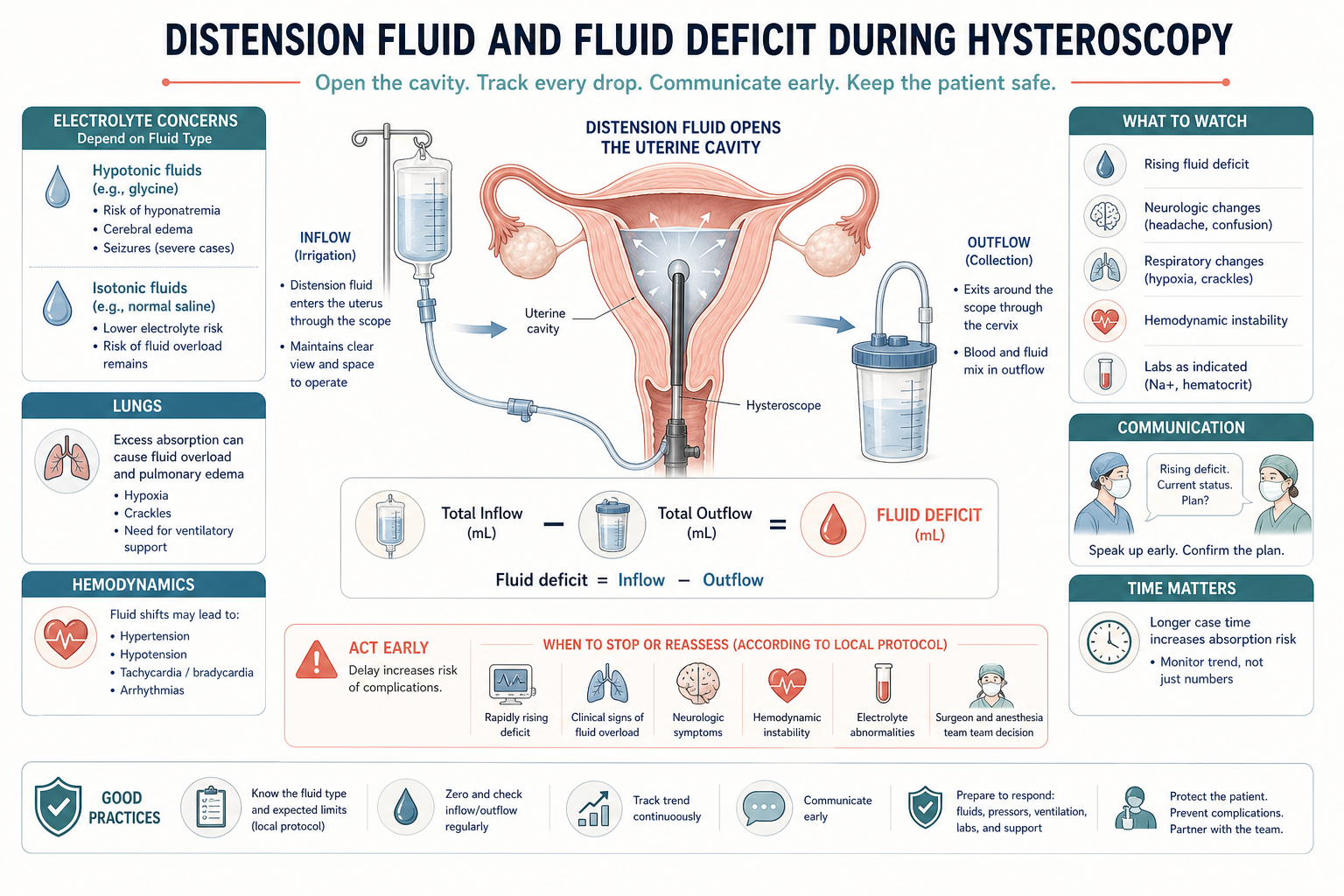
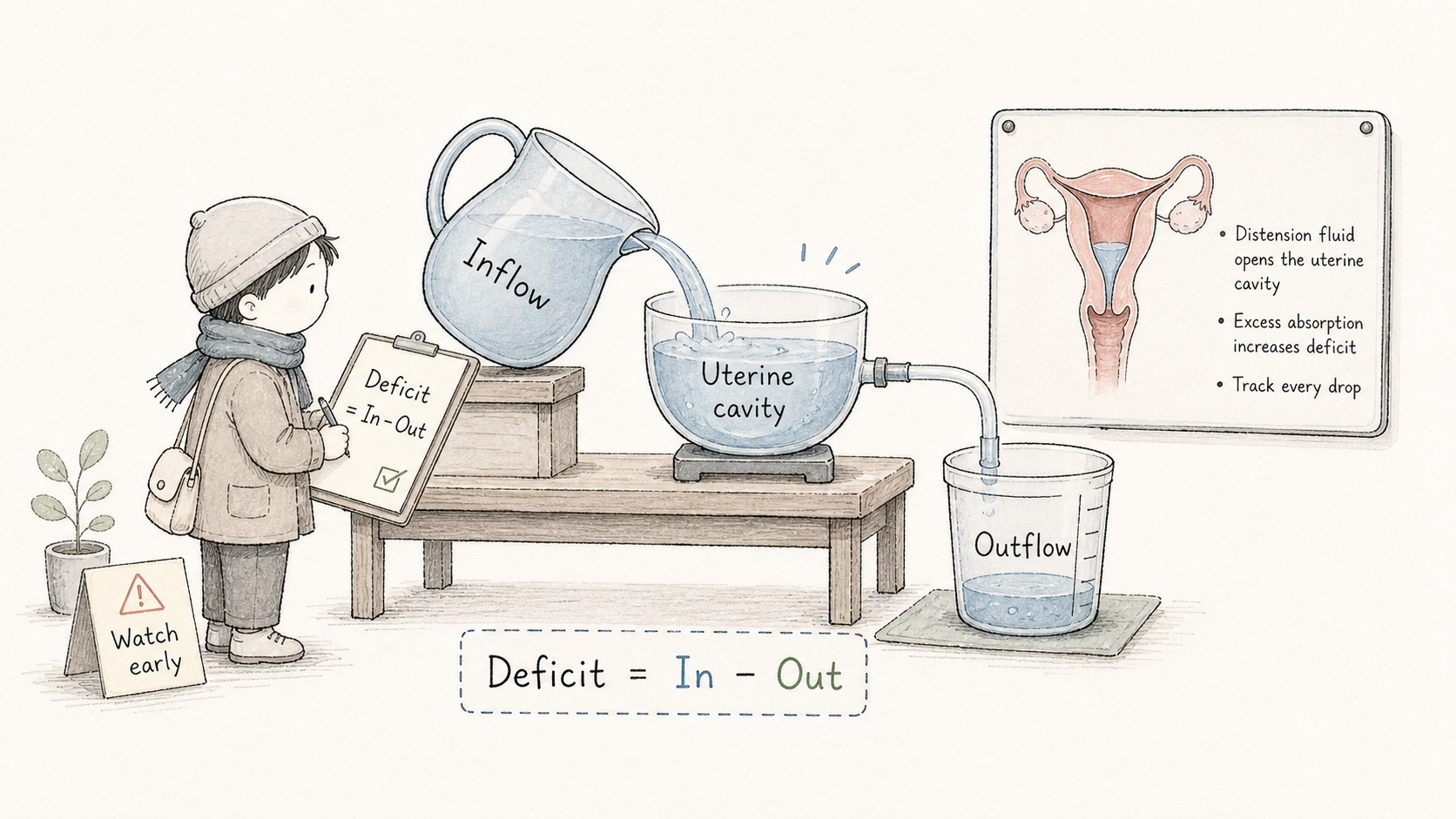
自学重点:Fluid deficit = Inflow - Outflow。看到液体袋和收集桶时,要想到“差值在变大吗?” Self-study key: Fluid deficit = Inflow - Outflow. When you see fluid bags and collection canisters, ask: is the deficit increasing?
Distension fluid and fluid deficit during hysteroscopy
图里可能有少量模型拼写瑕疵,正文以本节正确术语为准:distension fluid 和 fluid deficit。 The figure may contain minor generated text imperfections; use the terms in this section as the reference: distension fluid and fluid deficit.
Hand-drawn inflow outflow fluid deficit metaphor
手绘图把膨宫液变成水壶和杯子:进去多少、出来多少、差多少。 The hand-drawn figure turns fluid tracking into a simple water system: what goes in, what comes out, and the difference.

What Anesthesia Watches

麻醉医生术中看什么:短手术也有风险点What Anesthesia Watches: Short Does Not Mean Risk-Free

术中麻醉关注气道、SpO2、EtCO2、血压心率趋势、体位、出血、膨宫液差值、宫腔穿孔可能、疼痛和恶心呕吐。学生要练习把“手术步骤”和“监护仪变化”联系起来。

Intraoperative anesthesia priorities include airway support, SpO2, EtCO2, BP/HR trends, positioning, bleeding, fluid deficit, uterine perforation concern, pain, and PONV. The student should practice linking surgical steps with monitor changes.
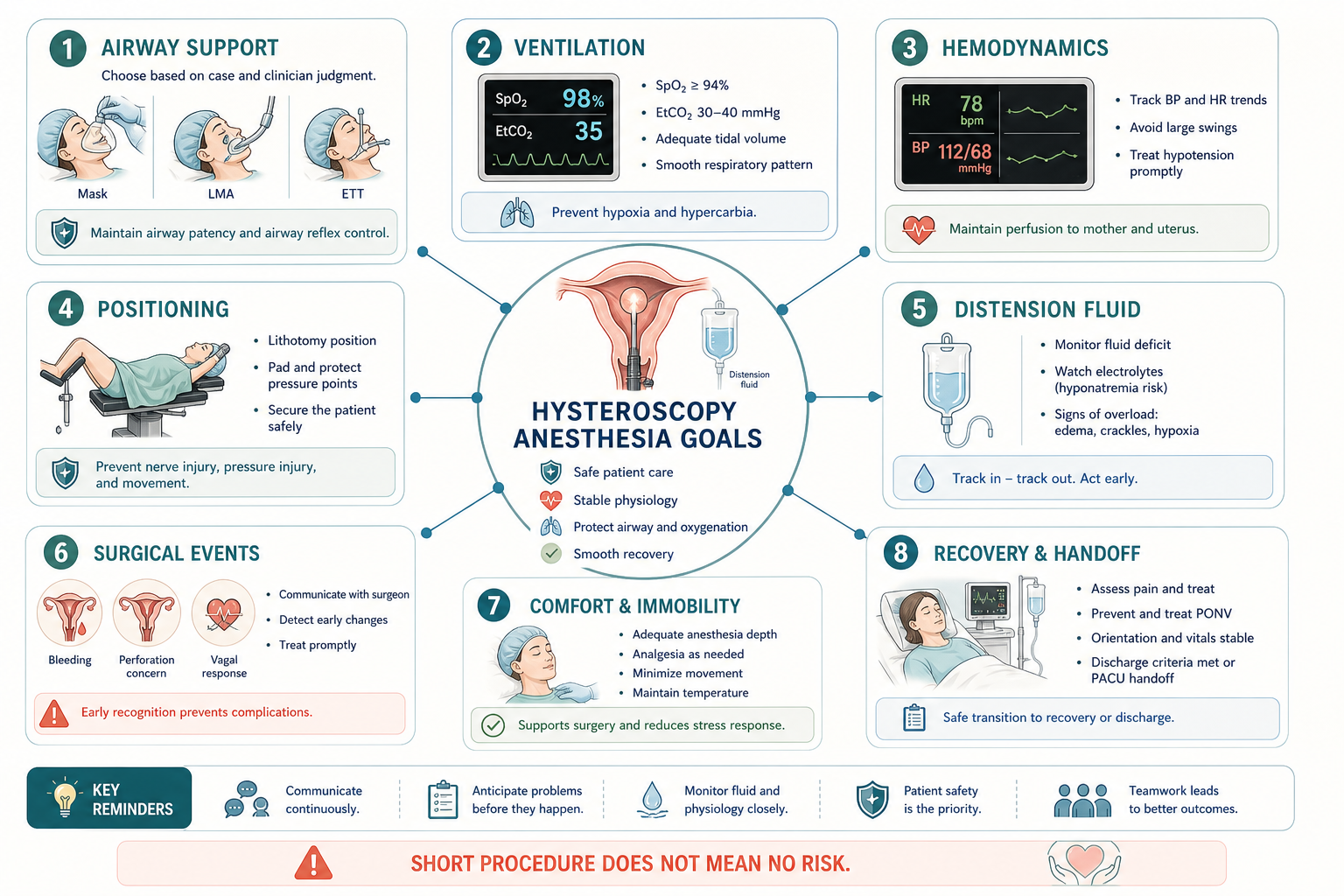
Anesthesia priorities during hysteroscopic surgery
这张矩阵适合术中自己对照:我现在应该观察哪一个系统? This matrix is useful during observation: which system should I be watching right now?

Self-Guided Observation Route

学生自己怎么观察:按六个节点走一遍How to Observe Independently: Follow Six Checkpoints

Pre-op 为什么做手术?有没有禁食、过敏、出血史、贫血、气道风险? Why surgery? Any fasting, allergies, bleeding history, anemia, or airway risk?
Sleep 诱导后病人如何进入舒适、无痛、稳定状态? How does induction create comfort, analgesia, and stability?
Airway 使用哪种气道支持?SpO2 和 EtCO2 如何确认通气? What airway support is used? How do SpO2 and EtCO2 confirm ventilation?
Scope 手术何时进入宫腔?什么时候看到息肉或出血来源? When does the scope enter? When is the polyp or bleeding source seen?
Fluid 膨宫液进出量怎么记录?Fluid deficit 是否升高? How are inflow and outflow tracked? Is the fluid deficit increasing?
Wake-up 苏醒是否平稳?疼痛、恶心、出血和意识状态如何? Is emergence smooth? What about pain, nausea, bleeding, and orientation?

Check Yourself

术后五个自测问题Five Post-Case Self-Check Questions

看完这台手术后,学生可以用 2 分钟回答:这台手术在治疗什么?宫腔镜为什么需要膨宫液?为什么选择全麻?麻醉医生最关注哪几个监测指标?PACU 交接需要听清什么?

After the case, answer in two minutes: What was this surgery treating? Why does hysteroscopy need distension fluid? Why was general anesthesia used? Which monitors mattered most to anesthesia? What should be included in the PACU handoff?

核心句:A short procedure can still teach real anesthesia thinking. Core line: A short procedure can still teach real anesthesia thinking.
← 返回线下交流 · 课件馆